About Us
Mechanica Labs is a research group. Our main work is mechanistic interpretability, and we also work on deep mine systems and mineral identification. Our papers have appeared at NeurIPS, ICLR, ICML and TAG-DS.
We want interpretability tools that work on more than one network. That only makes sense if different networks learn the same things, so much of our work tests whether they do.
We describe what a network has learned in the language of group theory, topology and geometry. Then we test the description. If it is right, replacing the network's neurons with the simple versions it predicts should leave the answers unchanged. Our mining work follows the same habit. A model of a mine is trusted only when its decisions hold up on cases it was not built from.
The mark
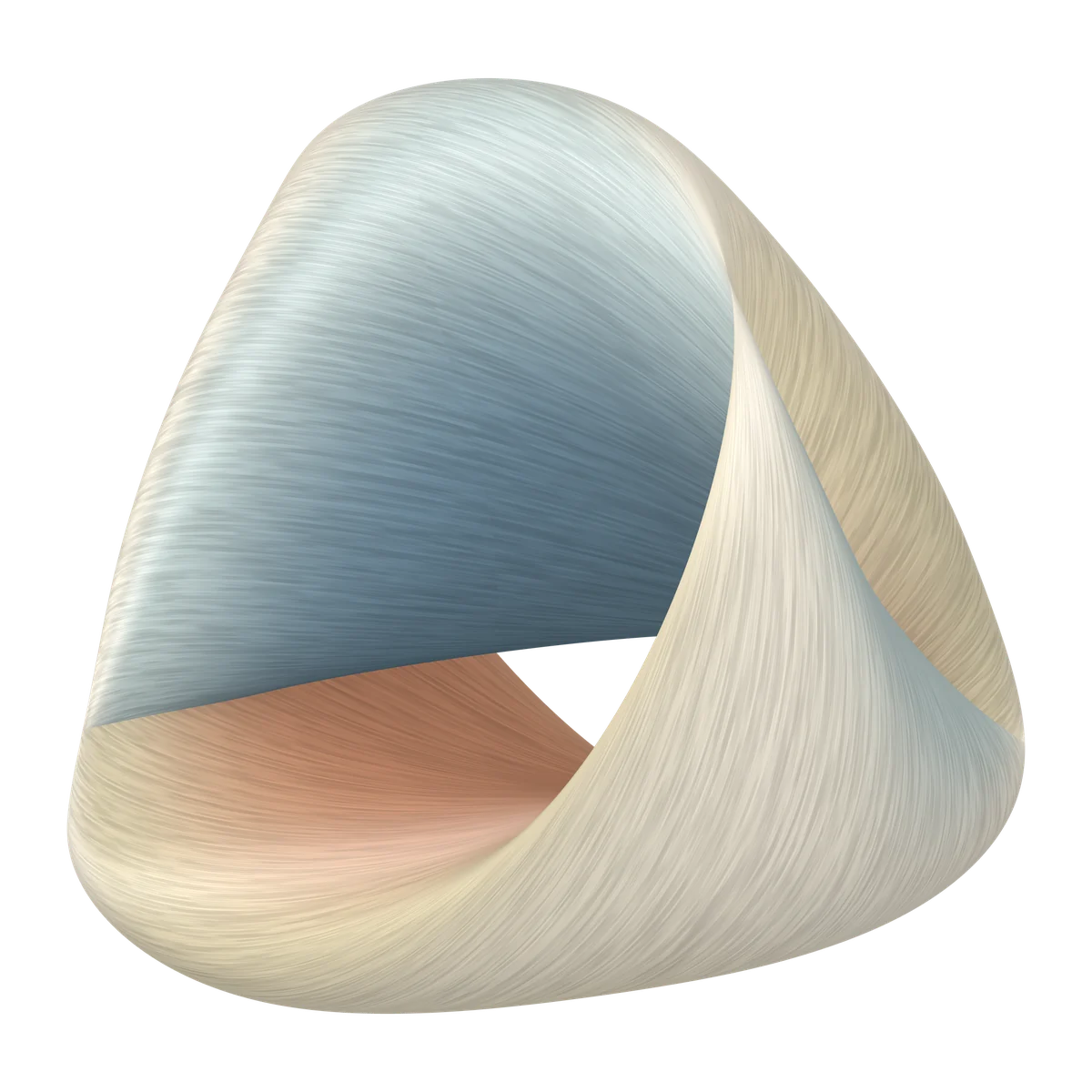
Our mark is a real object from Hamiltonian mechanics, computed rather than drawn. It is an invariant torus of the Hénon–Heiles system, the classic model of a star moving in a galaxy's gravitational field, and it shows where order survives inside chaos.
One regular orbit, at energy E = 0.08, was integrated and fitted as a smooth surface in four-dimensional phase space (x, y, px, py). The mark shows three of those dimensions. The fourth, hidden one sets the colour. That is why the sheets meet in clean two-tone edges where the surface folds past itself.
The fine texture runs along the orbit's true direction of flow. In the animation on our home page, loose strings drift and then wind onto the torus along its own flow lines. Every string is a piece of that orbit, so the strings become the surface.